
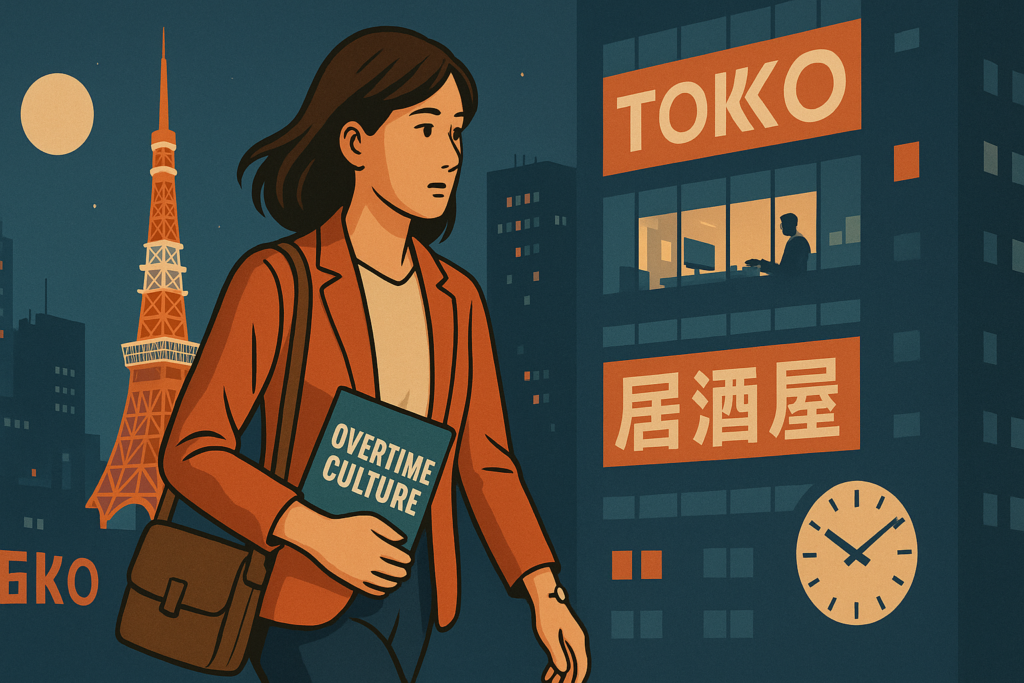
When I followed my then-boyfriend from Seoul to Tokyo, I packed two suitcases and a heart full of J-drama–fuelled optimism.
Romance, neon lights, conbini egg-sandwiches—what could go wrong?
Answer: the clock. Not the polite little wall clock above my desk, but the national one that seems permanently stuck on “overtime”. Japan’s famous service残業 (unpaid OT) quickly turned my fairy-light fantasy into a fluorescent all-nighter.
I spent two years reporting for a Japanese entertainment trade magazine. On paper my contract said 9 a.m.–6 p.m. Reality? I rarely escaped before 10 p.m., and midnight finishes were shrugged off as “しょうがない” (“it can’t be helped”).
The numbers look small—until you live inside them
Japan’s 2018 Work-Style Reform legally capped overtime at 45 hours a month (720 in emergencies). Employers who blow past that limit now face fines and, in theory, criminal penalties.
Sounds strict, right? Yet a 2024 government white paper admits one in ten workers still racks up 80 plus overtime hours each month—the level classified as a karōshi (death-by-overwork) red zone.
Behind every neat statistic is a life like mine: microwaving convenience-store curry at 11 p.m. because the last train is leaving and your Slack channel is still pinging.
Presenteeism is the real overtime clock
Korean workplaces can be hierarchical, but Japanese “face-time” culture is next-level. Nobody wanted to be the first to stand up. I once watched a colleague open a spreadsheet, place her phone inside the fold of her notebook, and secretly stream a drama while “working” because the section chief hadn’t left yet.
We weren’t lazy—just trapped. Managers assumed being present equaled being productive. If you slipped out at 7 p.m., you triggered a chorus of otsukaresama deshita (“you must be tired already”) heavy with sarcasm.
Add the obligatory post-work nomikai drinking—and the real end of the workday slid toward 1 a.m. Miss the last Yamanote Line? Pay for a taxi that costs more than your daily food budget or curl up in a karaoke booth until dawn.
Love in the time of line-item budgets
The relationship I’d crossed the Korea Strait for? It became collateral damage. My partner was a junior engineer in a black kigyō (so-called “black company” notorious for exploitation). His average week hit 70 hours. We developed a weird domestic routine: I’d fall asleep to the sound of him showering at 2 a.m.; he’d wake to me tip-toeing out at 6:30 for the commuter crush.
Weekends disappeared into recovery naps. We argued in hushed exhaustion about who forgot to buy rice. When we finally split, it wasn’t infidelity or cultural clashes—just overlapping burnout.
The silent costs: health, mind and money
Japan tracks karōshi cases officially: 883 people were recognized in 2023 as suffering serious mental-health disorders from overwork, including 79 suicides or attempts—the highest on record.
Unpaid overtime also bleeds wallets. A 2024 study following the reform found workers in “overtime-heavy” firms lost an average of ¥38,000 (≈ US$250) per month in uncompensated hours, while productivity barely budged.
I felt the toll physically. Digestive issues, eye twitches, chronic colds that never cleared because there was no time to see a doctor—just another konbini vitamin drink at my desk.
Coping hacks that actually helped
Time-blocking with radical transparency
I began logging every 15-minute slot in a shared sheet. Seeing my true workload on paper forced my editor to split assignments. (Yes, she was embarrassed.)
Learning the magic phrases
Saying “kisoku de dekimasen” (“the regulations don’t allow it”) carried more weight than “I’m tired.” Quoting law over feelings got tasks deferred.
Trading nomikai for one-on-one coffee
Skipping group drinking without alienating coworkers was tricky, but proposing a quick lunch set or konbini run built the same rapport minus the 2 a.m. shōchū shots.
Joining a union hotline
Japan’s Ministry of Health now runs a confidential karōshi hotline. A colleague’s anonymous complaint triggered a labour-standards inspection that finally put hard stops on weekend emails.
Intentional micro-joys
Cherry-blossom walks at Meguro River; 100-yen store stationery hauls; Sunday neighborhood sentō baths. Small rituals buffered the grind.
What changed—and what hasn’t—since I left
Back in Seoul, I still chase deadlines, but 8 p.m. is considered late. Japanese average annual working hours have fallen from 2,000 + in the 1980s to about 1,640 pre-pandemic, thanks partly to digital tools and government pressure.
Yet demographic labour shortages mean many companies quietly expect the same output with fewer heads, pushing surviving staff to stretch again. Consultants brag about four-day-week experiments, but my Tokyo friends tell me remote work often morphs into “always-on work”.
Would I move for love again? Yes—but with eyes open
Tokyo gave me impeccable konbini fried chicken, lifelong friends, and interview access to J-pop legends I’d only fangirled over. I don’t regret the leap. But I wish someone had warned me that passion for a person can’t outrun a national passion for overtime.
If you’re considering relocating to Japan for romance (or fandom, or ramen), pack these truths:
Contracts lie; corporate culture doesn’t. Ask future teammates, not HR, when they actually leave the office.
The last train is a curfew. Budget for taxis or choose housing on a 24-hour subway line.
Overtime laws exist—but you must invoke them. Learn the vocabulary, keep time sheets, and don’t be afraid to wave them (politely) at your boss.
Love needs sunlight. Schedule daytime dates—even if it means Sunday 7 a.m. breakfast—before fatigue makes conversation impossible.
I left Tokyo with a broken relationship but sharper boundaries. Today, when K-drama actors gush about filming all night “for the fans,” I file my story—and shut my laptop before the clock strikes ten. Some lessons from Japan, it turns out, are harder to unlearn than kanji.
AloJapan.com